Author
Alan of Lille
1120–1202
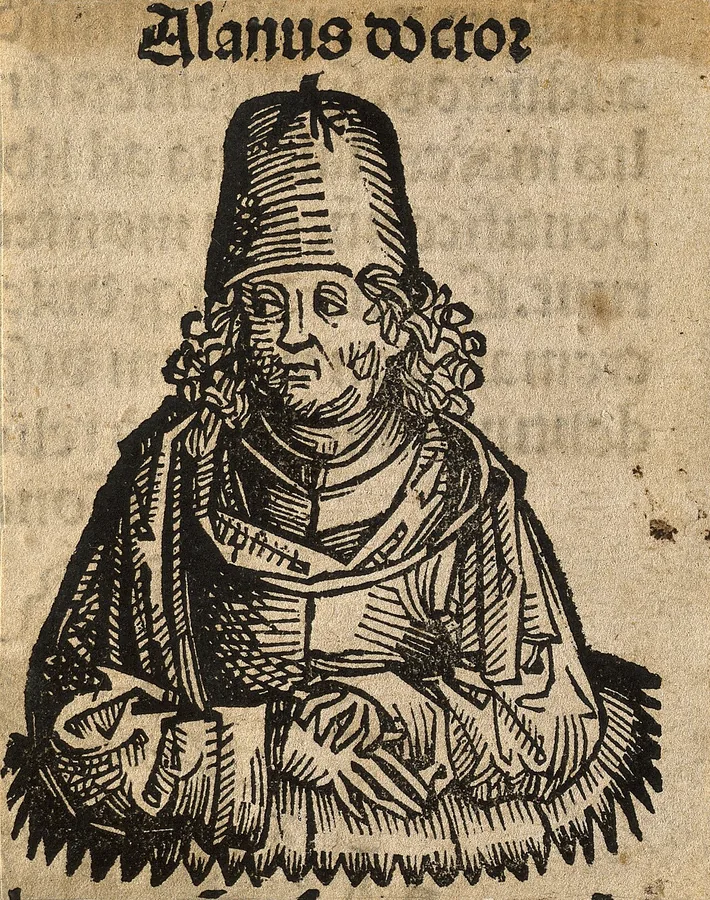
Alan of Lille (c. 1120–1202), known in Latin as Alanus de Insulis, was probably born at Lille in Flanders. He taught the liberal arts and theology at Paris and later in the south of France, where he preached against the Cathars, and he died at Cîteaux, where he had entered the Cistercian order late in life. His learning earned him the name Universal Doctor.
Unknown artist, Alanus de Insulis (Alain de Lille), woodcut, Wellcome Collection · CC BY 4.0
Works
13De angelica hierarchia
A short treatise by Alan on the order of angels.
De arte praedicatoria
Alan's manual for preaching, in which the best concepts are offered for composing sermons on almost every moral topic, with specific guidance on how to preach to various groups.
De fide catholica
In progress
Alan of Lille's De fide catholica contra haereticos sui temporis is a four-book late-twelfth-century exercise in Christian polemic.
De planctu naturae
Alan of Lille's De planctu naturae ("The Complaint of Nature") is a twelfth-century Latin prosimetrum in which personified Nature laments human disorder and the misuse of sexuality and language.
Expositio super orationem Dominicam
A commentary on the Lord's Prayer by Alan.
Expositio super symbolum Apostolorum
A commentary on the Apostles' Creed by Alan.
Expositio super symbolum Nicenum
A commentary on the Nicene Creed by Alan.
Liber parabolarum
Book of parables or proverbs by Alan.
Quod non est celebrandum bis in die
A letter by Alan of Lille explaining why a priest should not celebrate Mass twice in a day except in necessity.
Rhythmus de amore Veneris
A poem against the love of Venus, that is, lust, that warns of the ruin that comes from adultery.
Rhythmus de incarnatione Christi
A poem about how the seven liberal arts are related to the incarnation of Christ.
Rhythmus de miseria mundi
A poem in which the fleeting and perishable nature of man is graphically depicted.
Theologicae regulae
Alan's theological rules, wherein he sets forth over a hundred concise maxims.